

Turn Down Your Inner Commentary
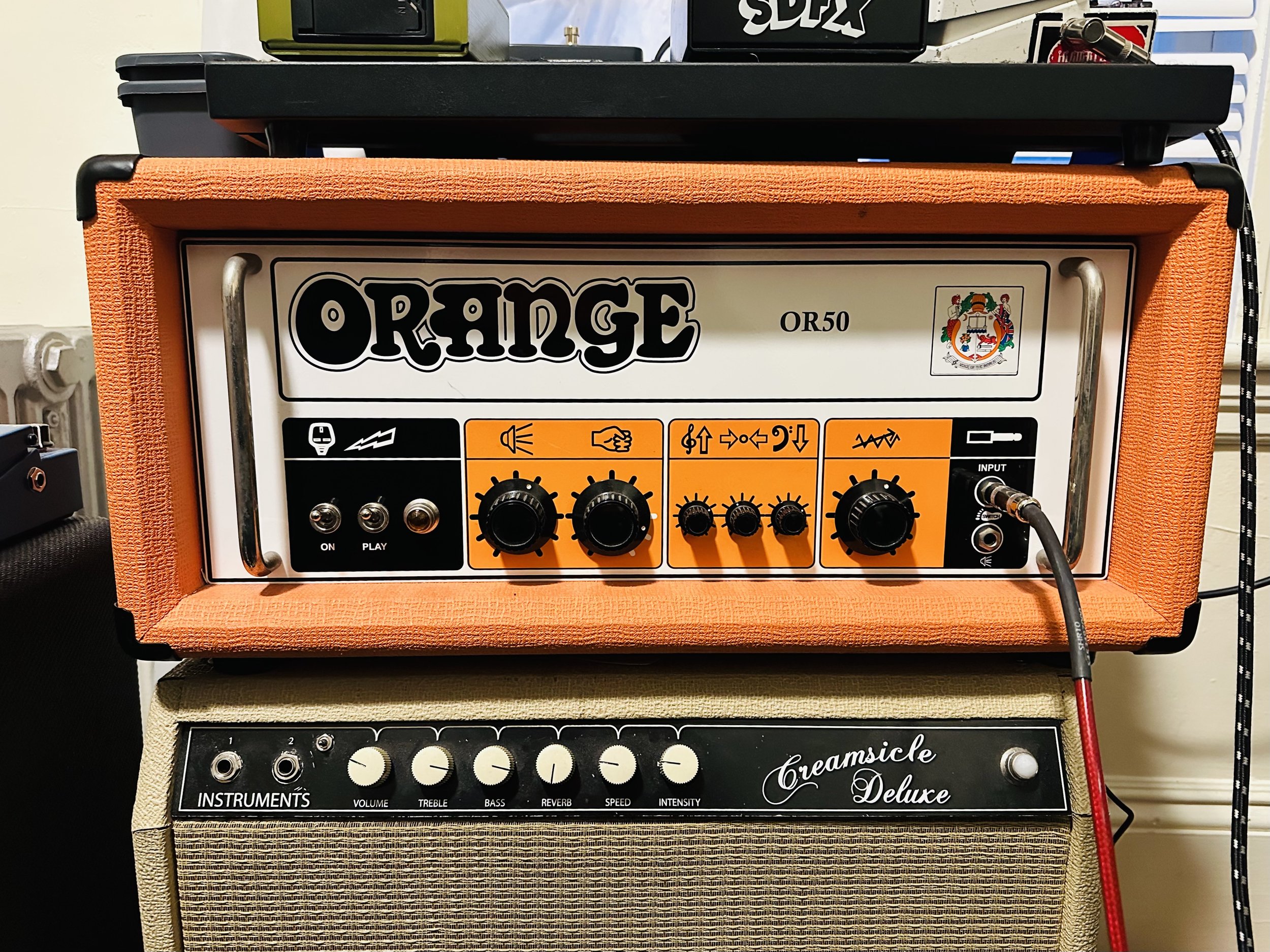
Sometimes I visualize turning down the knobs on my husband's amps. Photo by Quinn Corte, 2025.
Since I started coach training a couple years ago, I’ve been practicing being more mindful about my thoughts. I recently wrote about my practice of not rehearsing potential disasters. Another thing I’m working on is releasing the story about whatever is happening to me.
For example, I recently found myself lying in a dark hotel room on a sunny day in Rome with a migraine. In this moment, there are two layers of experience happening. One layer is fact: I’m in pain and must take care of my body. The second layer is story: “I’m missing out on everything.” “What’s wrong with me?” “This trip is ruined.”
The first layer (fact) is out of my control. It’s pain, but it’s unavoidable. The second layer (story) is within my control. It’s pain, and it’s completely optional. So optional, in fact, that I can now turn down the volume dial on the story until it’s completely muted.
In my coaching training, my teacher called these two layers of experience “clean pain” and “dirty pain.” Clean pain is the raw, unavoidable pain of the experience (the event or emotion), while dirty pain is all the extra suffering caused by your brain's story about the clean pain.
I don’t love the terms “clean pain” and “dirty pain," because they seem a bit judgy, and I think this is all so very human and normal. But a lot of my classmates found that terminology helpful, so I’m sharing in case it resonates.
Here’s another way of looking at it. In Buddhism, dirty pain is often referred to as the “second arrow.” The first arrow is the pain of what happens to us (“ouch, that arrow hurt”) and the second arrow is self-inflicted commentary about the pain (“I'm such a weakling for crying; it's just an arrow”).
So how can we alleviate the sting of that second arrow?
For me, it’s helpful to note that most of my anxiety is coming from my inner commentary. (Not from the thing that’s happening.)
Take the vacation migraine. The physical pain was awful, but it got exponentially worse when I got trapped in my inner prison—storytelling about the past (why is this happening to me?) and future (will this be the nightmare vacation I spent in bed?) and providing melodramatic narration (this is the worst thing that could have happened, and I am a defective human being.)
Luckily, I’ve been working with coaches and training to be one. So, I quickly nipped it in the bud.
It’s taken practice, but here’s what works for me.
As soon as I notice I’m stuck in a miserable thought loop, I step out of the loop and look at it.
I separate out the facts from the story.
I tell myself gently to “drop the commentary.”
My mental chatter gets very quiet, and my perspective shifts to my material reality.
I feel a sense of peacefulness and surrender.
Yes, I use this technique for migraines. But I also use this when I’m in acute crisis. I've spent way too much time recently in emergency rooms or waiting for test results, and I have to say—dropping the commentary is a survival strategy...and it works.
It’s a similar feeling to hitting "mute" when sports are on TV. Instead of drowning in a frenzy of noisy words, I'm suddenly just quietly watching the action unfold.
And once I turn down the volume on my inner commentary, I eventually notice a softer voice emerge. It’s an encouraging and soothing one that reminds me, “It's okay to be scared,” and “You’re doing great.”
Dialing down your harsh inner commentary is a skill that takes practice, but it pays off in spades.
As humans, we can’t protect ourselves from pain, but we certainly don’t have to pour salt in the (arrow) wounds.